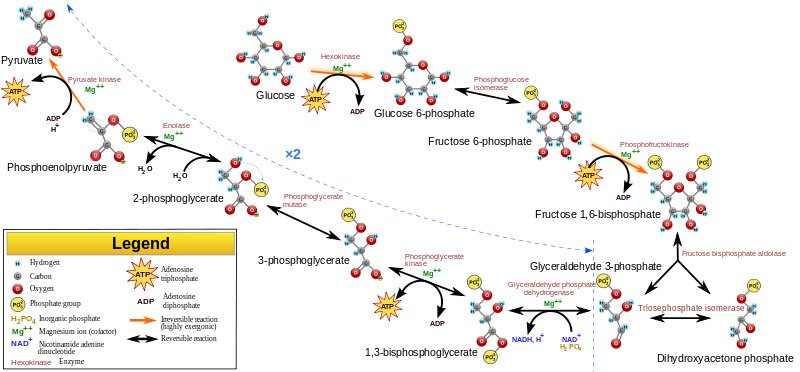
Glycolysis or the Embden-Meyerhof pathway is a metabolic pathway to begin the break down of glucose. This pathway is used by most autotrophic and heterotrophic organisms, both aerobes and anaerobes. Glycolysis does not require oxygen; however, it can occur in the absence or presence of oxygen. Glycolysis consists of four important steps:
- Glucose phosphorylation
- Breakdown of six-carbon molecule (glucose) into three- carbon molecule
- Transfer of two electrons to coenzyme NAD
- Energy capturing in ATP
The end products of glycolysis are two ATP molecules, two pyruvic acids, and two molecule of NADH.
Glycolisis由multiple steps where six-carbon molecules are broken down into two three-carbon molecules, and generate two ATP molecules, two pyruvic acids, and two molecules of NADH