Bioreactor is a mechanical microorganism and substrate vessel where biological conversion occurs in a controllable manner. The substrate will be biochemically processed by the microorganism, and the biochemical product can be harnessed. Sometimes, the word fermenter is used instead of bioreactor; however, both mean the same.
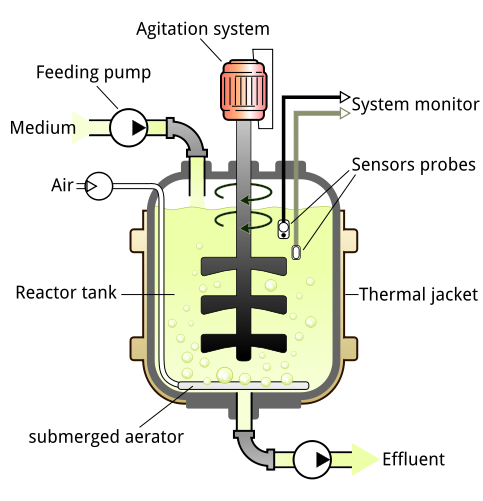 生物反应器部分包括以下几点:1。pH值monitor, 2. temperature monitor, 3. air outlet and inlet, 4. water/steam outlet and inlet, 5. nutrient inlet, 6. stirrer and 7. culture inlet "
The key for an effective bioreactor is to control and maintain the microbial growth and metabolite production inside the bioreactor. To achieve sustainable microbial growth and metabolite production, certain parameters must be controlled. Those parameters are as follows:
- Sterilization of media and vessel
- Sufficient substrate and growth factors (e.g., vitamins) in media.
- Agitation (stirring)
- Temperature control
- pH control
- Anti-foaming (During the fermentation foam is formed, which can disrupt the measuring equipment)
- Control overflow (used when media are added continuously)
- Aeration (oxygen supply for aerobic processes).
One of the worst things that can happen during fermentation experiments is to detect contaminants. Contaminants are unwanted microorganisms that compete with the original strain over nutrients, and disrupt the experiment. Contaminants can be detected microscopically, or from the dataset. A contaminant will often grow rapidly, thereby giving rise to very high CO2-levels, and a high biomass concentration relative to the product. It is extremely important to prevent contamination; therefore, the fermenter must be sterilized.