一些酶需要"helper-molecules" for catalysis to take place. These helper-molecules are called cofactors. Cofactors are non-protein molecules that bind to the enzyme and contribute to reactions in a number of different ways. Co-factors can either be inorganic ions, such as the Zn2+ions required byADH, or they can be more complex organic or metalloorganic molecules. If a co-factor is bound tightly (sometimes covalently) to the enzyme, it is termed a prosthetic group [1].
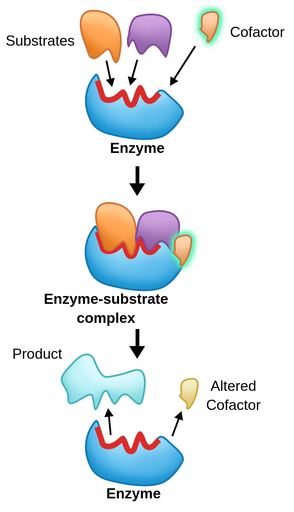
Figure 1:Illustrating the role of a co-factor. This co-factor binds the enzyme and contributes to the reaction, and leaves the enzyme with the product in a changed state. This could, for example, be a changed oxidation state, as is the case for NAD+, which then needs to be restored elsewhere before the co-factor can assist in another reaction.
References
- Lehninger, Albert L.; Nelson, David L.; Cox, Michael M. (2008).Principles of Biochemistry(5th ed.). New York, NY: W.H. Freeman and Company. ISBN 978-0-7167-7108-1.