In microbiology, growth is defined as an increase in the number of cells in a population. Generation time refers to the time taken for one cell to become two, both in terms of total cell number and mass. Each microorganism's generation time is determined by growth medium and incubation conditions used.
Growth rate
Batch culture is a closed-culture system which contains an initial, limited amount of a nutrient. In batch culture, microbial growth can be classified into four phases: the lag phase, log/exponential phase, stationary phase, and death phase. In some species, such asSaccharomyces cerevisiae, the exponential phase can occur twice with slightly different growth rates due to a switch in metabolic pathways.


Lag Phase
Cells adapting and synthesize new cell material in this phase. Cell divisions are at the minimum rate. In production fermentation, it is important to use inoculum that is used in the exponential phase to spend minimum time in the lag phase.
Exponential phase
Cells grow at a constant and maximum rate, which can be described by this equation:
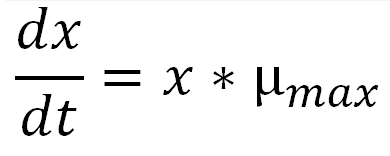
Note that the change in biomass is dependent on the concentration of biomass. Integration of the formula gives the following:

As seen, from the equation, μmaxcan be found in a plot of ln(x) versus time. The intercept of this plot will be ln(x0), and the slope will be μmax, also called the maximum specific growth rate.
Doubling time of cells is the time it takes for the biomass concentration to double. It can be calculated using formula below:

Yeast cells shows diauxic growth when grown aerobic on glucose. Diauxic means that there is two growth phases, separated by diauxic shift. Diauxic shift is a period of transition from glucose to ethanol as the substrate for growth and reproduction. During the initial exponential phase, yeasts utilize glucose as the carbon source, but when glucose becomes scarce, yeasts switch to the fermentation product, ethanol, as the carbon source. Yeasts continue to use ethanol until ethanol has been depleted and finally enter the stationary phase.
Stationary phase
Substrate or nutrient depletion and toxic product accumulation decrease and eventually cease the growth rate.
死亡期
Cells stop growing and the number of viable cells declines.
缩写
x: cell concentration (g l-1)
t: time of incubation (h)
μ:比生长速率(h-1)
xo: cell concentration at time zero or inoculum size (h)
t2: cell doubling time