In this example, we will useCoulomb’s lawto determine the electrostatic force between a proton and an electron in a very simplified classical model of the hydrogen atom.
First, we will determine the magnitudeof the force using the equation of Coulomb’s law.Then, we will determine the directionof the force, using the part of Coulomb’s law that states that particles with opposite charges attract and particles with like charges repel.
The electrostatic force between two particles depends on:
- Constant of Coulomb’s law (k): This is simply a constant of proportionality, it is always the same every time we use Coulomb’s law. Its value in the SI is8.99·109Nm2/C2.
- Charge of the first particle (q1): We can take this as theelectron. The charge of the electron in the SI is1.60·10-19Cand it isnegative in sign.
- Change of the second particle (q2): We can take this as theproton. The charge of the proton in the SI is1.60·10-19Cand it is积极的信号. Notice that it is the same quantity of charge as the electron, but it has a different sign.
- Distance between the particles (r): We will take this to be the radius of the hydrogen atom, which is5.29·10-11m.
库仑定律的方程是:
Fe= k |q1|·|q2|/r2.
We substitute the values of the data we have gathered in the equation:
Fe=(8.99·109Nm2/C2)·(1.60·10-19C)· (1.60·10-19C)/(5.29·10-11m)2=8.22·10-8N
This is themagnitudeof the electrostatic force.
Now, we must determine itsdirection. The force actsalong the line that joins the two particles, but it could be an attractive force (which pulls them together) or a repulsive force (that drives them apart). The electron and the proton have charges ofopposite signs. Because opposite chargesattract, the force pulls the electron and the proton together, acting in the line that joins them. That is the direction of the electrostatic force.
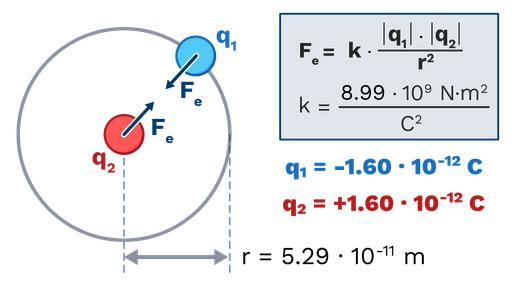
Figure:Simplified version of the hydrogen atom. The arrows point in the direction of the electrostatic forces in this situation.