促红细胞生成素(EPO) is a glycoprotein hormone produced in the kidney. EPO promotes red blood cell production. A single gene located in chromosome 7 regulates the production of erythropoietin, which primarily takes place in the kidneys. Approximately 10% of erythropoietin is synthesized in the liver and other extra-renal organs.

Structure
Initially, erythropoietin is a protein 193-amino acid in length, without biological activity. Shortly before secretion, the N-terminus leader sequence of 27 residues is cleaved, leaving only 166 amino acids. When erythropoietin enters the blood stream, the amino acid arginine is lost, leaving a final sequence of 165 amino acids. The functional erythropoietin shows two disulfide bridges formed by the amino acid cysteine at position 7 and 161, as well as 29 and 33. The molecular weight of an erythropoietin peptide backbone is 18.000 Dalton. After undergoing post-translational modification, glycosylation, the molecular weight of erythropoietin becomes 30.000 Dalton. 40% of erythropoietin is composed of three N-linked carbohydrate structures, located at Asp-24, 38, and 83, and one O-linked carbohydrate structure, located at Ser-126.
Function
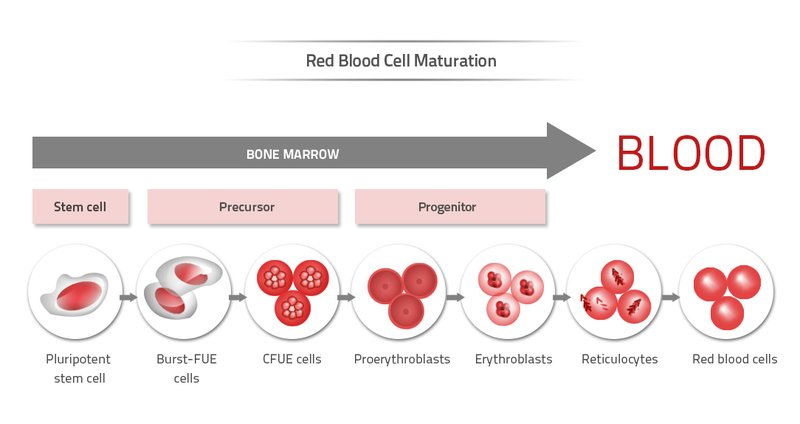
The erythropoietin molecules that enter the blood stream are carried to the bone marrow. After erythropoietin reaches the erythrocyte mother cells, it triggers the production of erythrocytes by stimulating the proliferation and differentiation of erythroid precursors in different stages, the first stages including burst-forming units (BFU-E) and the second stage including colony forming units (CFU-E).
Hypoxia triggers the production of erythropoietin. Hypoxia is a condition in which the body, or a region of the body, is deprived of adequate oxygen supply.