Human erythropoietin was first purified in 1977 from 2500 liters of urine from an anemic patient. Following this event, in 1985 the human erythropoietin cDNA sequence was mapped. Today, with advances in molecular genetics engineering, it is possible to synthesize recombinant human erythropoietin in various cell types.
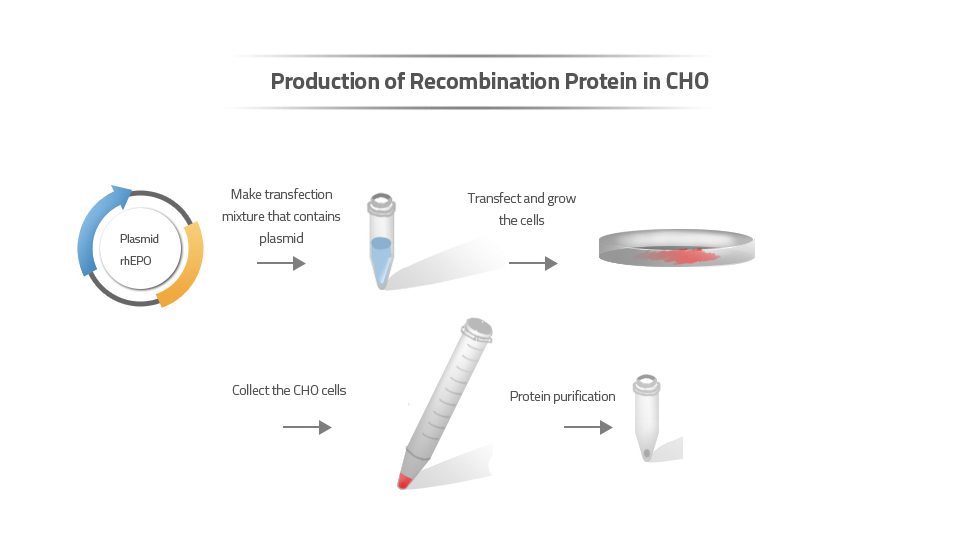
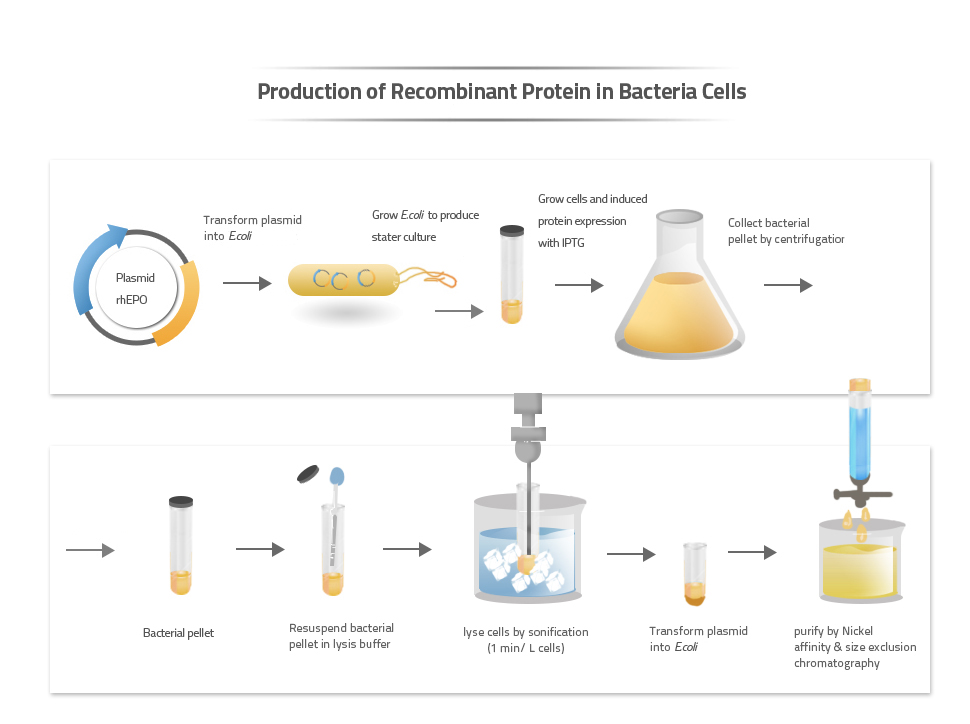
The first step of synthesizing recombinant proteins is to clone the DNA sequence that encodes the protein of interest into a vector (i.e. plasmid). The vector is then inserted into an expression system of choice. The expression system can be cells of bacteria, yeast, mold, mammals, plants or insects. Each expression system has its own advantages and disadvantages that determine protein quality, functionality, and yield. In this lab, we use two types of expression systems representing eukaryote cells (CHO cells) and prokaryote cells (Escherichia coli).
Bacteria
E.coliis one of the most widely used and well-studied expression systems. This system is excellent for expression of functional non-gycosylated proteins. Bacteria did not develop a sophisticated mechanism for performing posttranslational modifications. The following table summarizes the advantages and disadvantages ofE.colias an expression system.
| Advantages | Disadvantages | |
|---|---|---|
| Rapid expression | Protein with disulfide bonds is difficult to express | |
| High yield | 生产unglycosylated蛋白质 | |
| Ease of culture and genome modification | Protein produced with endotoxin | |
| Inexpensive | Acetate formation resulting in cell toxicity | |
| Mass production is fast and cost effective | Protein produced as inactive inclusion bodies that requires refolding |
Recombinant human erythropoietin synthesized inE.coli是不稳定的,你好gh temperatures and tends to aggregate.
Mammalian
Mammalian cells, primarily Chinese hamster ovary (CHO), are often used as an expression system for synthesis of protein that needs post-translation modification, such as glycosylation. The mammalian cell system is the only expression system that can perfectly duplicate the complex structure of biological active erythropoietin that comprises two disulfide bridges and four glycosylation sites. The recombinant human erythropoietin synthesized in mammalian cells is more stable due to its 40% carbohydrate component. The following table summarizes the advantages and disadvantages of mammalian cells as an expression system.
| Advantages | Disadvantages | |
|---|---|---|
| Capable of post-translation modification, including phosphorylation and glycosylation | Expensive | |
| Protein produced is properly folded | Poor secretion |