Regularly examining the morphology of the cells in culture (i.e., their shape and appearance) is essential for successful cell culture experiments. In addition to confirming the healthy status of your cells, inspecting the cells by eye and a microscope each time they are handled will allow you to detect any signs of contamination early on and to contain it before it spreads to other cultures around the laboratory.
Most mammalian cells in culture can be divided into three basic categories based on their morphology:
- Fibroblastic: cells are bipolar or multipolar, have elongated shapes, and grow attached to a substrate. One example isfibroblasts.
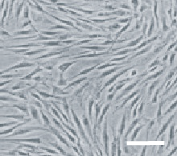
图1:Fibroblasts in culture.
- Epithelial-like: cells are polygonal in shape with more regular dimensions, and grow attached to a substrate in discrete patches.
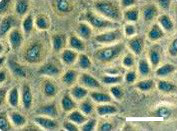
Figure 2:角膜上皮细胞在文化。
- Lymphoblast-like: cells are spherical in shape and usually grown in suspension without attaching to a surface.
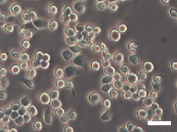
Figure 3:Lymphoblasts in culture.
In addition to the basic categories listed above, certain cells display morphological characteristics specific to their specialized role in the host. Neuronal cells exist in different shapes and sizes, but they can roughly be divided into two basic morphological categories, type I with long axons and type II without axons.

Figure 4:Neurons in culture.