Nuclear Chemistry: Understand the processes happening in the atomic nucleus Virtual Lab
Have you ever wondered what’s inside the atomic nucleus? Why are some elements radioactive? What is radioactivity? The Nuclear Chemistry simulation will teach you the answer to these questions, and many more!



Try our lab safety simulation
Discover one of our 200+ learning simulations today
- Description
- Features
About the Nuclear Chemistry: Understand the processes happening in the atomic nucleus Virtual Lab
Radioactivity is something that only happens in nuclear power plants, right?
In this simulation, you will learn that radioactivity is much more common than you might think—in fact, you are surrounded by it! You will also learn what types of atoms are radioactive and why, and how alpha, beta, and gamma decay generate different types of radioactivity.
Understand the processes happening in the atomic nucleus
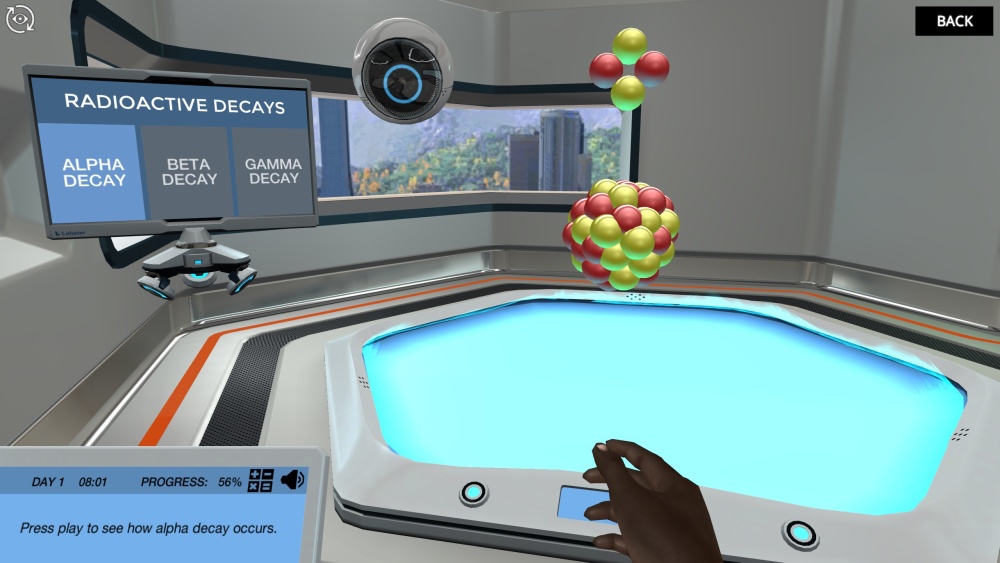
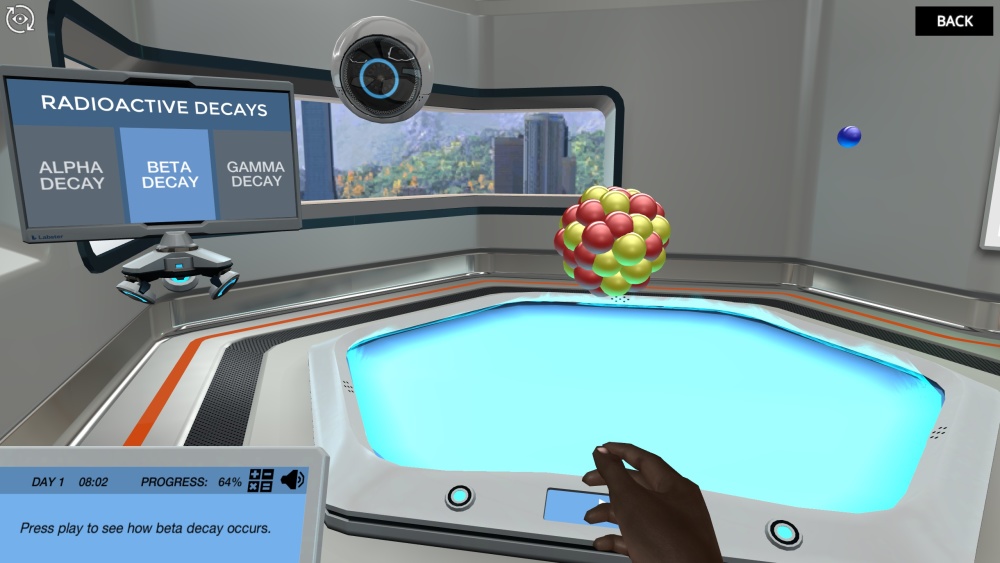
Use our holofloor to visualize how protons and neutrons interact in the nucleus. Experiment with stability of isotopes and figure out why some combinations are more stable than others.
Analyze properties of alpha, beta, and gamma decay
Radioactive isotopes can undergo alpha, beta, and gamma decay. Each of these processes generates radioactivity; luckily, we are in a virtual simulation and we can experiment with these isotopes without being exposed to harmful levels of radiation. Additionally, you will be able to see how protons and neutrons interact in the nucleus thanks to our advanced holofloor.
Learn and put it into practice!
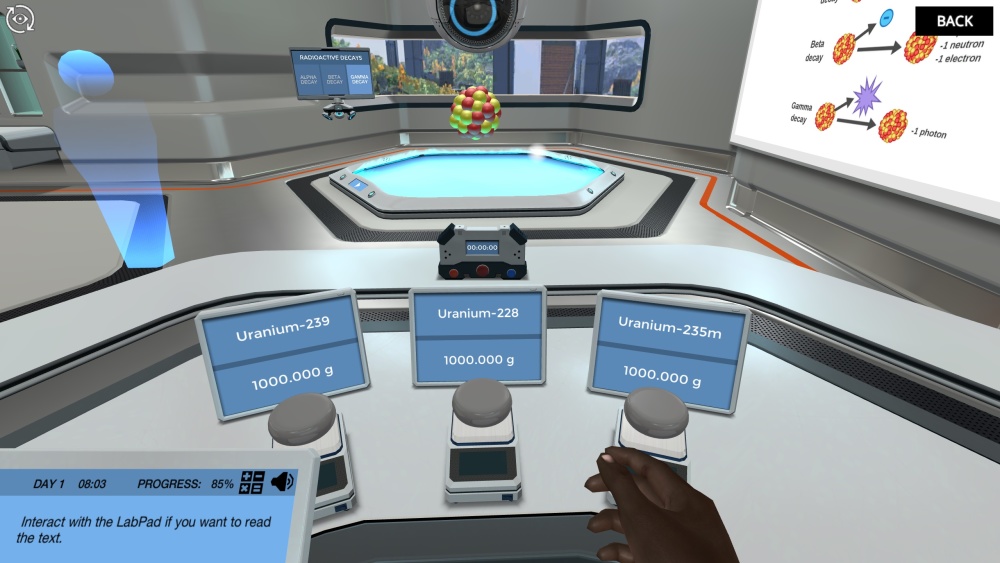
首先,您将了解如何粒子在交互e nucleus and how alpha, beta, and gamma decay occurs. Then you’ll put those concepts into practice. With the help of only a scale, you will need to figure out the type of decay that three different isotopes are undergoing.
Have you ever wondered what’s inside the atomic nucleus? Why are some elements radioactive? What is radioactivity? The Nuclear Chemistry simulation will teach you the answer to these questions, and many more!
At the end of this simulation, you will be able to...
- Identify common subatomic particles and energies involved in nuclear reactions
- Recognize common modes of radioactive decay (alpha, beta, gamma) by observing differences in nucleic mass defect and/or binding energies
- Explain the concept of half-life
- Describe common applications of radioactive isotopes (nuclear medicine, radiometric/carbon dating, nuclear energy)
- Describe how carbon dating works
Length: 25 Minutes
Accessibility mode: Not available
Languages: English (United States)
HS-PS1-8
Chemistry C.3 Nuclear fusion and fission
Unit 5: Kinetics