The cerebrum is the largest and most superior part of the brain. It is responsible for the perception and integration of sensory information, control of motor functions, and complex functions such as language, memory, and personality.
It consists of the left and right hemispheres. The surface of the hemispheres is covered by a 2-4 mm thick layer ofgray matter,cerebral cortexenveloping the internal white matter, which consists of tracts carrying impulses. Deep within thewhite matter, we can also find thebasal nuclei, which are islands of gray matter.
Gray matter in the CNS consists mainly of the cell bodies of the neurons, while the white matter is built up of mainly myelinated axons, which also gives it its whiteness.
The surface of the cerebrum has a wrinkled, walnut-like appearance. The folds are calledgyri(singular: gyrus). The deep furrows between gyri are called裂缝, while the shallower furrows are calledsulci(singular: sulcus). Many of the sulci, fissures, and gyri are important anatomical landmarks, such as thelongitudinal fissure, that divides the cerebrum into the left and right hemispheres. These hemispheres are connected by a thick bundle of axon fibers, the corpus callosum, which allows communication between the two hemispheres.
The sulci and gyri can also be used to help identify the locations of the five lobes of the cerebral hemispheres:额,parietal,occipital,temporaland theinsula.
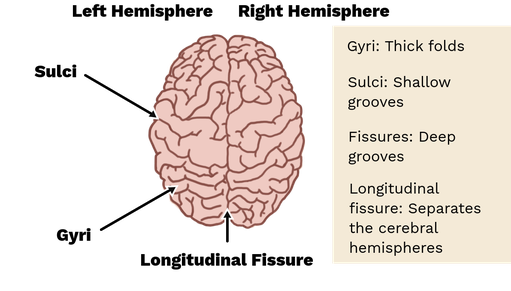
Figure 1.Structures of the cerebrum