An SN1 reaction is a nucleophilicsubstitution reactionin which the rate-determining step involvesonecomponent. The reaction name derives fromSstanding for 'substitition',Nfor 'nucleophilic' and the1denoting the kinetic order of the reaction - or simply the number of reaction components involved in the rate-determining step.
SN1 reactions are two-step, unimolecular reactions and proceed via an intermediatecarbocation. The first carbocation-forming step is the slower of the two and therefore determines the rate of the reaction. The second step involves the rapid attack of the nucleophile to the newly-formed carbocation. The reaction has two transition states, one before and one after the intermediate. Lowering the energy of these transition states will lower the activation energy of the reaction.
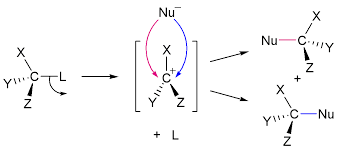
Figure 1:General SN1 reaction mechanism. L is the leaving group. Nu is the nucleophile. The carbocation intermediate is an electrophile.
Unlike theSN2 reaction- in which we seeinversionof stereochemistry in the product -the SN1 reaction provides aracemicproduct. Racemization of the stereochemistry takes place as the nucleophile is able to approach the planar carbocation intermediate from either side, providing both product立体异构体.
Factors that affect the SN1 reaction:
SolventPolar, protic solvents usually speed up the rate of an SN1 reaction, as their large dipole moment helps to stabilize the intermediate carbocation. Polar, aprotic solvents are not used in SN1 reactions because some of them can react with the carbocation intermediate and provide unwanted products.
NucleophileSince the nucleophile is not involved in the rate-determining step on an SN1 reaction, the strength of the nucleophile does not affect the reaction. However, if you have more than one nucleophile competing to bond with the carbocation, you could end up with a mixture of products. (Sometimes a solvent can act as a nucleophile too!)
Leaving groupThe better theleaving group, the faster the SN1 reaction. This is because the leaving group is involved in the rate-determining carbocation formation step.