Eukaryotic genes consist of the following building blocks:
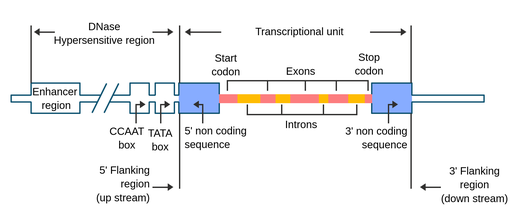 Figure 1.基因。
Remember that these building blocks are simply编码的核苷酸。下面的g are the most important gene components:
Promoter: the DNA sequence located near the 5’ end of the coding region, where RNA polymerase and transcription factors bind and initiate the transcription. Generally, a promoter consists of two sequences: a recognition sequence (where RNA polymerase binds) and a TATA box (where DNA starts to denature).
增强器: The transcription control element that is located one Mbp away from the gene. It binds the activator (also referred to as transcription factor) by bending the DNA.
Poly(A) signal: DNA sequence (AAUAAA) located at the 3’ end of the coding region. This sequence signals the site of cleavage of the pre-mRNA transcript by an enzyme, after which a poly(A) tail is added. Terminators, which signal the end of transcription, can locate hundreds of nucleotides downstream of the poly(A) signal.
Exon: Expressed regions or coding regions. This part of the gene encodes the mRNA.
Intron: Intervening regions or non-coding regions. These sequences are spliced out of the mRNA precursor before it leaves the nucleus.
These DNA motifs are recognized by specialized proteins that interact with the DNA and regulategene expression。